
If you’ve spent any time in a gym, you’ve almost certainly come across the bro split. It’s one of the most recognisable training styles out there—simple, structured, and heavily associated with traditional bodybuilding.
Alongside approaches like Push Pull Legs (PPL), it’s one of the most common ways people structure their training.
But just because something’s popular doesn’t automatically make it effective for everyone. The bro split has its strengths, but it also comes with limitations that are worth understanding before you commit to it.
What Is Bro Split
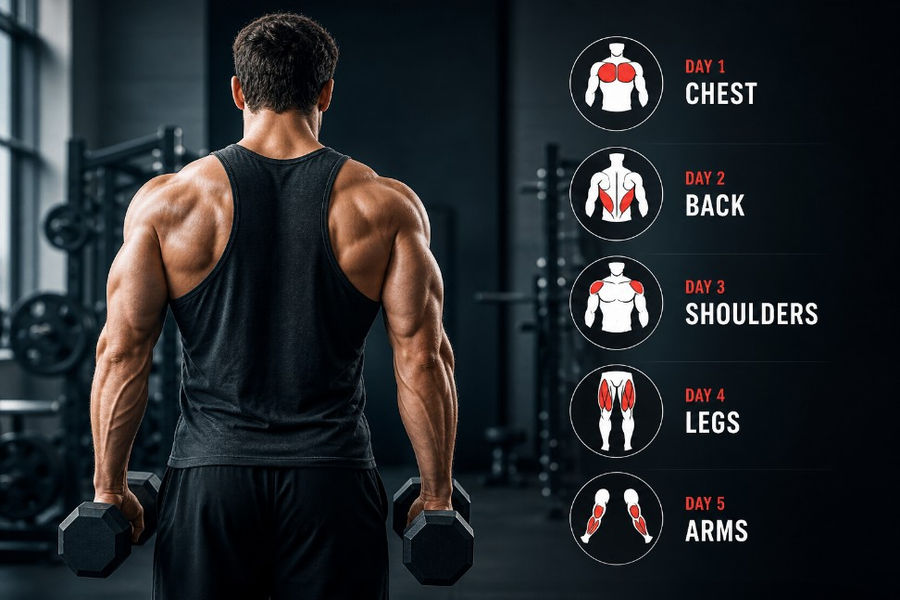
A bro split is a weight training routine where you train one muscle group per session, typically across five days of the week.
A common setup looks like this:
- Monday: Chest
- Tuesday: Back
- Wednesday: Shoulders
- Thursday: Legs
- Friday: Arms
Each workout focuses heavily on a single muscle group, often with high volume—multiple exercises and sets targeting that area from different angles.
The idea is straightforward: you hit one muscle hard, then give it plenty of time to recover while you train other areas. By the time you come back to it the following week, it’s fully recovered and ready to go again.
This style became popular through bodybuilding culture, particularly in the era of magazine routines and early online fitness forums.
Why People Still Use It

There’s a reason the bro split hasn’t disappeared—it does work, especially in certain situations.
For one, it allows you to really focus on a specific muscle group. You’re not rushing through a full-body session or trying to balance competing priorities. That can lead to a strong mind-muscle connection, which is useful for hypertrophy.
It’s also easy to follow. There’s no complicated structure or rotating schedule. You know exactly what you’re training each day, which makes it approachable for beginners and convenient for regular gym-goers.
Another benefit is recovery within a session. Because you’re only targeting one area, you can train it thoroughly without worrying about fatigue affecting other lifts in the same workout.
Where It Falls Short
The biggest criticism of the bro split is frequency.
Most people using this routine only train each muscle group once per week. Research and practical experience both suggest that hitting a muscle group more than once weekly is generally more effective for building muscle—something approaches like Push Pull Legs (PPL) are designed to do.
There’s also the issue of missed sessions. If you skip a day, that muscle group might not get trained at all that week. With other splits, like upper/lower or push/pull, you’ve got more flexibility to catch up.
Finally, sessions can become very long and fatiguing. Training one muscle group with high volume in a single workout can lead to diminishing returns, where later sets aren’t as effective because of fatigue.
Bro Split Workout
If you want to try a bro split, here’s a straightforward five-day routine you can follow:
Day 1: Chest
- Barbell bench press – 4 sets of 6–10 reps
- Incline dumbbell press – 3 sets of 8–12 reps
- Chest fly (machine or dumbbell) – 3 sets of 10–15 reps
- Cable crossovers – 3 sets of 12–15 reps
Day 2: Back
- Pull-ups or lat pulldown – 4 sets of 6–10 reps
- Barbell row – 3 sets of 8–12 reps
- Seated cable row – 3 sets of 10–12 reps
- Face pulls – 3 sets of 12–15 reps
Day 3: Shoulders
- Overhead press – 4 sets of 6–10 reps
- Lateral raises – 3 sets of 12–15 reps
- Rear delt fly – 3 sets of 12–15 reps
- Upright rows – 3 sets of 8–12 reps
Day 4: Legs
- Squats – 4 sets of 6–10 reps
- Leg press – 3 sets of 10–12 reps
- Hamstring curls – 3 sets of 10–15 reps
- Calf raises – 4 sets of 12–20 reps
Day 5: Arms
- Barbell curls – 3 sets of 8–12 reps
- Tricep pushdowns – 3 sets of 10–12 reps
- Hammer curls – 3 sets of 10–12 reps
- Overhead tricep extensions – 3 sets of 10–12 reps
Rest on the weekend, or add light cardio and mobility work if you want to stay active.
Who This Approach Works Best For

The bro split can be a solid choice if your main goal is hypertrophy and you enjoy longer, focused sessions in the gym.
It tends to suit intermediate lifters who already have a good understanding of exercise technique and can push sets close to failure safely.
It can also work well if you simply enjoy the structure. Consistency matters more than the “perfect” routine, and if this setup keeps you motivated, that’s a genuine advantage.
How To Make It More Effective
If you do want to run this style of training, there are a few ways to improve it.
You can increase training frequency by lightly hitting muscle groups twice per week. For example, adding a few chest exercises on shoulder day or some arm work on back day.
Another option is to reduce volume per session and spread it across the week. Instead of doing 15–20 sets for one muscle in a single workout, you might split that into two shorter sessions.
Progressive overload is still key. You need to be gradually increasing weight, reps, or overall training quality over time. Without that, no split will deliver results.
Should You Use It?
The bro split isn’t outdated—it’s just not universally optimal.
If you enjoy it, can train consistently, and push yourself properly, you can absolutely build muscle with this approach. But if you’re looking for maximum efficiency, especially as a natural lifter, you may get better results from routines that train each muscle group more frequently.
Like most things in fitness, the best plan is the one you can stick to—and the one that actually moves you forward.