

If you’ve ever had back pain that keeps coming back, you’ll know how it can affect everything — your workouts, your job, even how you sit on the sofa. The temptation is to rest it completely, but too much rest can actually make things worse in the long run. The real key to a healthier back isn’t doing less — it’s getting stronger in the right way.
A strong, stable back helps you move better, lift more safely, and cut down the risk of flare-ups. The goal isn’t to power through pain, but to rebuild the support system around your spine — your glutes, core, and postural muscles — so that your back can do its job without strain.
Why Strength Matters More Than Stretching Alone
Stretching can bring short-term relief, but it won’t fix the underlying problem if your back muscles are weak or your core isn’t doing its share of the work. Strength training, done properly, builds the stability that keeps your spine in good alignment and prevents overloading.
That’s why a well-rounded routine is often more effective than endless stretching sessions. It helps restore balance: stronger glutes mean less pressure on your lower back, and a stronger core means better control over every movement you make.
The Key Muscles That Support Your Spine
When it comes to long-term back health, several muscle groups make the difference:
- Glutes: The powerhouse of your posterior chain. Weak glutes shift work onto your lower back.
- Core stabilisers: Your deep core muscles (like the transverse abdominis) act as a built-in back brace.
- Erector spinae and lats: Keep your spine upright and help with controlled bending and lifting.
- Upper-back postural muscles: The rhomboids and traps counteract slouching and shoulder rounding.
Train these properly, and you’re not just easing discomfort — you’re protecting yourself against future problems.
The Foundational Exercises
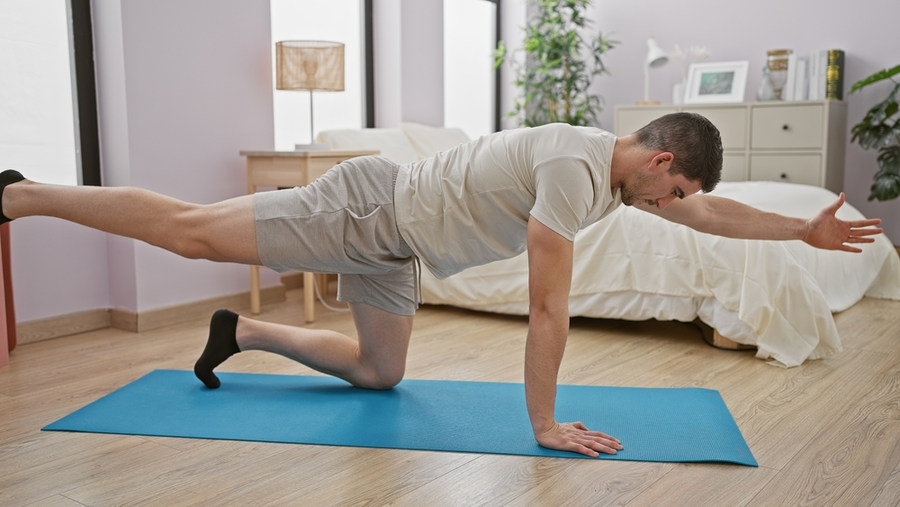
Here’s a set of low-risk, strength-building movements designed to help you develop resilience without overloading your back. Move slowly, focus on form, and stop if anything feels painful.
- Bird Dog
A classic stability drill that trains your core and lower back together. From all fours, extend one arm and the opposite leg. Keep your hips level, hold for a few seconds, then switch sides. - Glute Bridge
Lie on your back with knees bent, feet flat on the floor. Lift your hips until your body forms a straight line from shoulders to knees. Squeeze your glutes at the top. To progress, add a resistance band or try single-leg variations. - Cat-Cow Stretch
Start on hands and knees. Alternate between arching your back and rounding it gently. It helps improve mobility and body awareness — ideal for warming up before strength work. - Superman Hold
Lie face down, lift your arms and legs slightly off the floor, and hold for five to ten seconds. Keep your neck neutral and avoid arching too high. Builds endurance in your erector spinae. - Bodyweight Row (Using a TRX or Bar)
Engages your lats, traps, and rear shoulders without compressing your spine. Maintain a tight core and pull your chest up to the handles or bar. - Dead Bug
Lie on your back with arms and knees raised. Slowly lower one arm and the opposite leg while keeping your lower back gently pressed into the floor. This builds deep core stability and control. - Light Dumbbell or Kettlebell Deadlift
If your back pain isn’t acute and your form is solid, this movement is excellent for long-term strength. Focus on hinging at the hips rather than bending at the waist. Start light and build up gradually.
Always listen to your body. If any movement increases pain, stop and consult a physiotherapist before continuing.
How To Build A Back-Friendly Routine

Start with two or three sessions per week, spacing them out so your muscles can recover. A simple routine might look like this:
- Bird Dog – 3 sets of 10 each side
- Glute Bridge – 3 sets of 12
- Bodyweight Row – 3 sets of 8–10
- Dead Bug – 3 sets of 10 alternating reps
- Cat-Cow – 1–2 sets of 10 as a mobility finisher
It doesn’t have to be intense. The aim is control, consistency, and gradual progression. Over time, this kind of work builds the foundation you need for more demanding lifts.
Smart Recovery For A Stronger Back
Recovery is just as important as training. Gentle walking, swimming, or light cycling help improve blood flow and reduce stiffness. Sleep well, move often, and take short breaks from sitting throughout the day.
A quick stretch between meetings or a standing break every 30 minutes can do more for your back than an occasional big workout.
Building Confidence, Not Fear
Back pain can make you cautious — understandably so. But once you learn how to move with strength and control, that caution turns into confidence. Each rep is a step toward a back that’s not just pain-free, but powerful.
You don’t need to train like an athlete to protect your spine. You just need to keep moving, keep strengthening, and stay consistent — stronger, not sorer.