
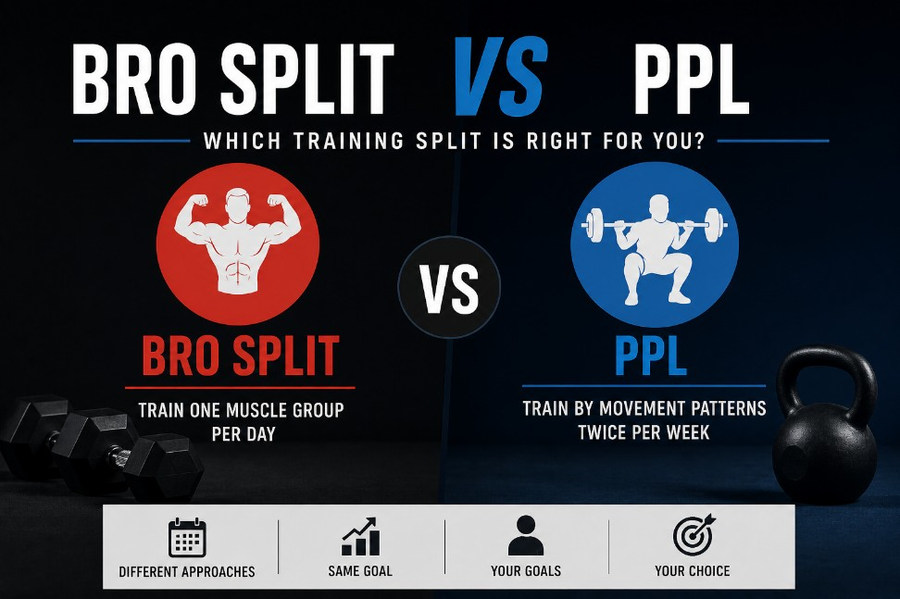
If you’ve been training for a while—or even just browsing fitness content—you’ve probably come across both the bro split and Push Pull Legs (PPL). They’re two of the most popular ways to structure your training, and on the surface, they can both look effective.
The problem is, they approach training very differently. And if you’re trying to decide between them, it’s not just about which one is “better”—it’s about which one actually fits how you train, recover, and make progress.
What Is The Difference Between Bro Split And PPL
The core difference comes down to how your training is organised.
A bro split focuses on one muscle group per session. You’ll typically train five days per week, hitting each muscle once.
A common setup looks like this:
- Chest
- Back
- Shoulders
- Legs
- Arms
Push Pull Legs, on the other hand, groups muscles by movement patterns. Instead of isolating one muscle per day, you train related muscle groups together.
- Push: Chest, shoulders, triceps
- Pull: Back, biceps
- Legs: Lower body
The result is a big difference in frequency. With a bro split, you usually train each muscle once per week. With PPL, you’re often hitting each muscle twice.
That one shift changes a lot about how each approach works in practice.
Training Frequency And Muscle Growth

This is where the biggest practical difference shows up.
With a bro split, you’re putting all your volume for a muscle into one session. That can mean long workouts and a lot of fatigue by the end. You might start strong, but later sets often drop in quality.
With Push Pull Legs, you spread that same volume across multiple sessions. Instead of doing everything in one go, you hit the muscle again later in the week while it’s recovered.
In practical terms, that often means:
- More high-quality sets per muscle across the week
- Less drop-off in performance within a single session
- More consistent stimulation for growth
That doesn’t make the bro split ineffective—it just means it relies more on getting a lot right within a single workout.
Workout Structure And Fatigue
The bro split is simple. One muscle, one focus, one goal for the session.
That makes it easy to stay locked in. You’re not worrying about overlapping muscle groups or managing fatigue across different lifts. You just train that muscle hard and move on.
Push Pull Legs is more interconnected. On push day, your chest, shoulders, and triceps all work together. That’s efficient, but it also means smaller muscles can fatigue earlier and limit performance on later exercises.
The same applies on pull days, where grip, biceps, and upper back all come into play.
So the trade-off looks like this:
- Bro split: maximum focus within a session, but more fatigue built up on a single muscle
- PPL: better fatigue distribution across the week, but shared fatigue within sessions
Neither is automatically better—it depends on how you prefer to train and what you respond to.
Time Commitment And Flexibility
This is where a lot of people make the wrong call.
A bro split is typically built around five training days. Miss a session, and that muscle group might not get trained at all that week. There’s not much room to adjust without reshuffling everything.
Push Pull Legs is more flexible—but only if you use it properly.
You can run PPL as a 3-day, 4-day, or 6-day routine. That makes it easier to adapt around your schedule. If you miss a session, you can usually pick up where you left off without skipping an entire muscle group.
In real terms:
- If your schedule is inconsistent, PPL is usually easier to keep on track
- If you reliably train five days per week, a bro split fits neatly into that structure
- If you only have 3–4 days available, PPL can be scaled down more easily
This is one of the most important factors, and it’s often overlooked.
Progression And Long-Term Results

Both approaches rely on the same principle: progressive overload.
If you’re not gradually increasing weight, reps, or overall training quality, neither split will deliver results.
That said, PPL tends to make progression easier to track. Because you’re repeating the same movement patterns more often, you get more opportunities to improve lifts within a shorter timeframe.
With a bro split, you might only revisit a lift once per week. That can slow down feedback and make progression feel less consistent.
Another practical difference is how volume is managed.
With a bro split, you might do 15–20 sets for a muscle in one session. With PPL, that same volume is usually split across two sessions, which often leads to better performance on each set.
Again, it’s not a dealbreaker—but it’s a meaningful difference in how progress feels week to week.
Who Should Use A Bro Split
The bro split still has its place.
It’s a better fit if you:
- Prefer longer, single-focus sessions in the gym
- Enjoy really targeting one muscle group at a time
- Train consistently five days per week without missing sessions
- Don’t want to train the same muscle multiple times per week
It can suit intermediate lifters who already have solid technique and can push hard within a single session.
Who Should Use Push Pull Legs
Push Pull Legs is generally the more adaptable option.
It’s a better fit if you:
- Want to train each muscle group more than once per week
- Prefer slightly shorter, more frequent sessions
- Have a schedule that changes week to week
- Want a structure that’s easier to adjust without skipping muscle groups
For natural lifters in particular, the increased frequency often lines up well with recovery and progression.
A Quick Reality Check Before You Decide

Most people overthink training splits and underdeliver on consistency.
If you’re a beginner, neither of these is likely to be your best option. A simple full-body routine done consistently will usually outperform both.
If you’re an early intermediate, Push Pull Legs often makes more sense because it balances frequency and volume without becoming overly complex.
If you’re more advanced, either approach can work well—as long as your programming, effort, and recovery are in place.
The split itself isn’t the limiting factor at that point.
How To Choose Between Them
Rather than asking which one is “better,” it’s more useful to look at your situation.
Ask yourself:
- How many days per week can I realistically train?
- Do I prefer focused sessions or spreading work across the week?
- How consistent is my schedule?
- Do I tend to miss sessions or stick to a routine?
Your answers to those questions will usually point you in the right direction.
Making The Right Call For Your Training
Both the bro split and Push Pull Legs can build muscle and strength if they’re applied properly.
The difference is in how they fit into your routine.
The bro split gives you simplicity and focus, but less flexibility and lower frequency. Push Pull Legs gives you more balance and adaptability, but requires a bit more awareness of fatigue and scheduling.
Neither is inherently better—they just solve different problems.
The goal isn’t to pick the “perfect” split. It’s to pick one that fits your training, stick with it, and actually make progress over time.