
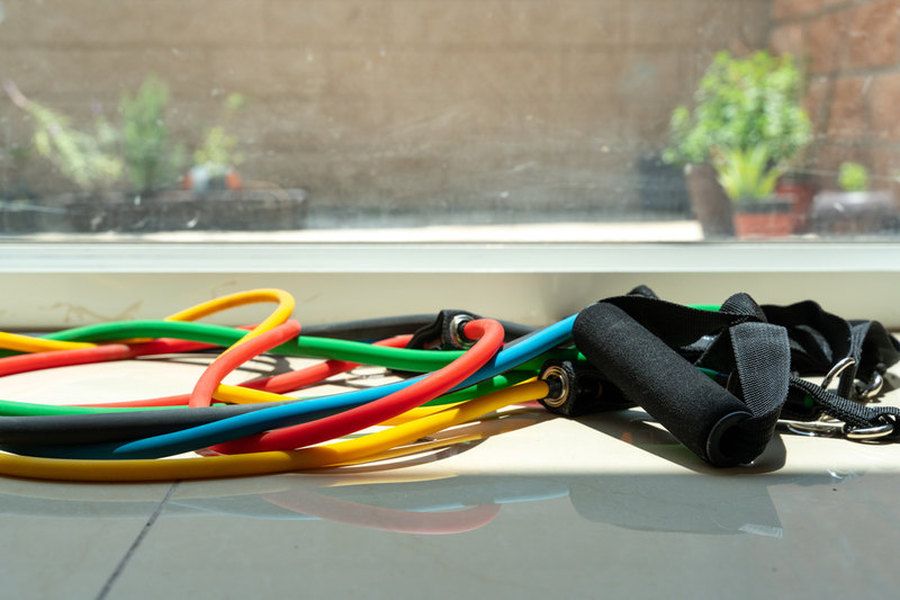
Resistance bands have a funny reputation. Some people treat them like serious training kit. Others see them as the thing that comes free with a yoga mat, gets used twice, then disappears into a drawer.
The truth sits somewhere in the middle. Resistance bands are worth using, but only if you understand what they are good for. They are not magic, and they are not a complete replacement for a proper gym setup if your main aim is heavy strength training. But they can be one of the most useful, affordable and convenient pieces of fitness equipment you can own.
How Resistance Bands Work
Free weights use gravity. A dumbbell, kettlebell or barbell pulls downwards, so the resistance depends on the angle of the movement and where the weight sits in relation to your joints.
Resistance bands work differently. The more the band stretches, the more resistance it creates. That means the exercise usually gets harder towards the end of the movement. A banded bicep curl may feel manageable at the bottom but much harder near the top.
This is called variable resistance. It is not better or worse by default; it is just different. With free weights, the load is easier to measure. With a band, the resistance changes depending on the band thickness, how far it is stretched, where you anchor it, and how worn it is.
What Resistance Bands Are Best At
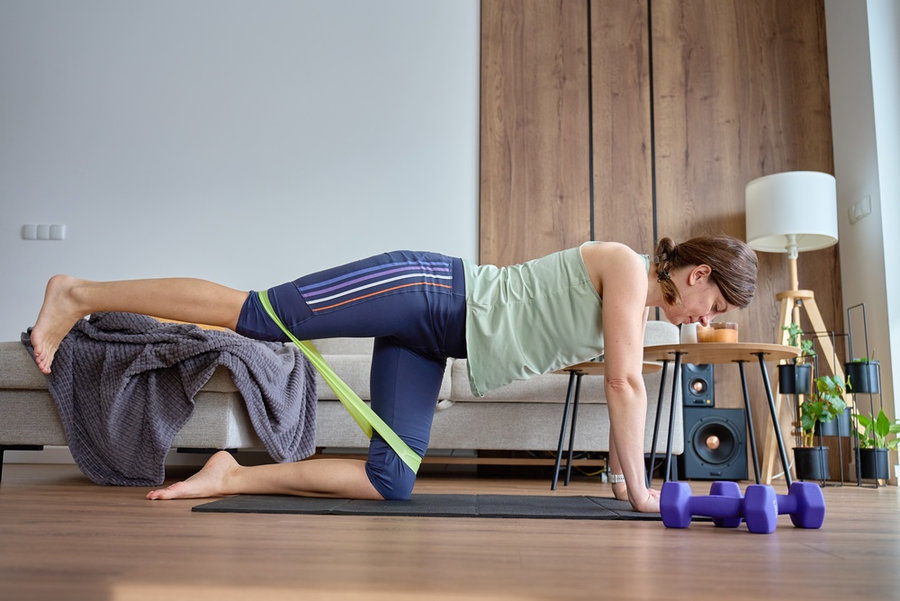
The best use case for resistance bands is convenient resistance training when weights are not practical.
That might mean training in a hotel room, keeping a simple setup at home, warming up before lifting, adding extra tension to bodyweight exercises, or doing accessory work without needing more equipment.
Travel is the obvious example. A decent set of bands takes up almost no room in a bag, weighs very little, and gives you enough options to train your shoulders, back, chest, arms, glutes and legs. You are not going to recreate a heavy squat rack in a hotel room, but you can still do rows, presses, curls, lateral raises, pull-aparts, glute bridges, squats and core work.
Where Bands Beat Free Weights
Resistance bands are hard to beat for portability, price and convenience. You can keep them in a drawer, take them outside, pack them for a weekend away, or use them when the gym is too busy.
They are useful for warm-ups too. Band pull-aparts, external rotations, face pulls and lateral walks can help you prepare for bigger lifts. They are especially handy for shoulders, hips and glutes because you can create resistance from angles that are awkward with dumbbells.
Where Free Weights Still Win
Free weights are better if your main goal is heavy strength, serious muscle-building progression, or precise tracking.
The reason is simple: progression is clearer. You can add 2.5kg to a bar, move from 12kg dumbbells to 14kg dumbbells, or track your sets and reps with a known load. With bands, it is harder to know exactly how much resistance you are using. Moving your feet, standing further from the anchor point, or using an older band can all change the difficulty.
Free weights are also better for heavy lower-body training. Bands can make squats, hip hinges and lunges harder, but most people will outgrow them if they want serious leg strength. At some point, a loaded barbell, leg press, hack squat, dumbbell split squat or Romanian deadlift is simply easier to progress.
That does not make bands pointless. It just means they are not the best tool for every goal.
Who Should Use Resistance Bands?

Resistance bands are a good idea for beginners who want an approachable way into strength training. They allow people to practise movement patterns without immediately worrying about heavy weights, complicated machines or busy gym floors.
They can also be a smart option for older adults, especially those who want to maintain strength, stay active at home, or build confidence with resistance training. Bands can be used standing, seated, or with support nearby, which makes them more adaptable than many gym exercises. They are not automatically risk-free, and anyone dealing with pain, balance problems, a recent injury or a medical condition should get proper advice first, but for many older people they are a practical way to train the muscles needed for everyday movement.
They are also useful for regular gym-goers. Bands can be brilliant for accessory exercises, warm-ups, mobility work, finisher sets and smaller muscle groups that do not always need heavy loading.
They suit people who travel often, train at home, work long hours, or need a quick session that does not involve setting up loads of kit. They are also useful for anyone who wants a cheap backup option for days when getting to the gym is not happening.
How To Get More From Them
The biggest mistake with bands is treating them like a novelty rather than a training tool.
You still need structure. Pick exercises that match your goal. Use a band that makes the last few reps challenging. Control the movement instead of snapping the band back. Track what you do, even if that means noting the band colour, your foot position, the anchor point and the rep range.
For muscle-building, take sets close enough to fatigue that the muscle is properly challenged. For warm-ups, keep the effort lower and focus on control. For travel workouts, use circuits or supersets to make lighter resistance more demanding.
A single light band will not challenge your whole body. A small set with different resistance levels is far more useful.
So, Are Resistance Bands Worth It?
Yes, resistance bands are worth it, but not because they are secretly better than weights. They are worth it because they solve problems.
They make training easier to fit into real life. They let you exercise while travelling, train at home, warm up properly, add variety, maintain strength as you get older, and keep moving when your normal routine falls apart. They are cheap, portable and surprisingly versatile.
Free weights are still the better choice for heavy, measurable progression. But bands do not have to compete with them. For most people, the best answer is not resistance bands or weights. It is both, used properly.
That integrates older adults without making it feel bolted on or changing the article’s main angle.