

Few sports ask as much of the body as rugby, which in the space of eighty minutes, players are required to sprint, absorb contact, wrestle for possession, recover, and do it all again. The training required to meet those demands produces a level of all-round physical conditioning that is difficult to replicate in a gym or on a running track alone.
Why Rugby?
With the inaugural Nations Championship 2026 just around the corner, there’s no better time to take a deep dive into the health benefits of rugby. So whether you play contact rugby at a club, join a tag league at your local ground, or take up walking rugby later in life, the sport develops fitness across every major physical domain.
Building Functional Strength
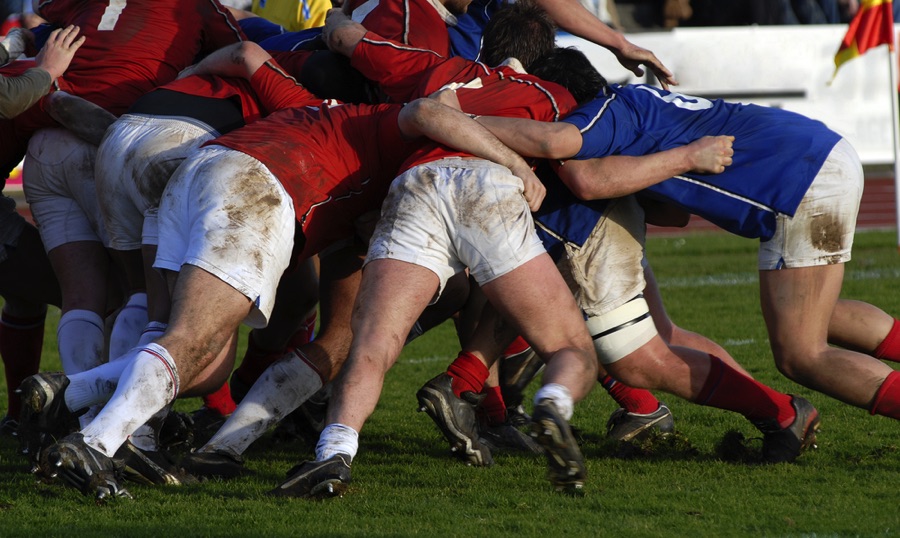
Strength in rugby is not the isolated, muscle-by-muscle kind developed on a weights machine, it demands the ability to produce high levels of force across nearly every technical and tactical situation simultaneously.
As World Rugby’s conditioning framework describes, scrummaging, mauling, tackling, lifting and sprinting all load the body at once, and the training that supports this builds strength through compound, whole-body movement patterns. It is the kind of functional strength that carries directly into everyday life.
Cardiovascular Fitness and Endurance
Rugby places simultaneous demands on both the aerobic and anaerobic energy systems that few other sports match. The stop-start nature of the game means the body is constantly switching between high-intensity explosive efforts and lower-intensity recovery: sprinting into a tackle, competing at a ruck, then walking back to position.
According to World Rugby’s endurance guidance, well-developed aerobic fitness allows players to move effectively and recover efficiently across the full eighty minutes. Over time, this dual demand produces cardiovascular conditioning that is both broad and robust.
Speed, Power and Explosive Movement

Victor Velter | Shutterstock
A common misconception about rugby is that speed matters less than in other field sports, when in practice acceleration over short distances is one of the game’s most decisive physical qualities.
World Rugby note that rugby speed is multifaceted, combining physical output with cognitive demands such as reading play and reacting to opponents. Power, the ability to express force quickly, underpins sprinting, tackling, jumping and contact absorption. Training these qualities together develops explosive athleticism that can be applied anywhere.
Functional Competence: Moving Well
Alongside the headline physical qualities, rugby training develops what World Rugby terms functional competence: the stability and mobility needed to move well under pressure. The sport requires players to maintain balance and body control during contact, change direction sharply, and brace through collisions.
The movement patterns involved, including squatting, hinging, pushing and pulling, mirror the demands of daily physical life. Developing this kind of functional base reduces injury risk and supports long-term physical health in ways that purely gym-based training often does not.
Mental Resilience, Discipline and Teamwork

OSCAR GONZALEZ FUENTES | Shutterstock
The physical benefits of rugby sit alongside mental and social ones that are equally well documented, and in some ways more distinctive. World Rugby’s lifestyle guidance identifies self-control, concentration, discipline, decision-making and leadership as key mental skills the sport develops through structured participation.
The research backs this up: a study of 500 rugby union players conducted by the University of Edinburgh found that 9 in 10 reported that the sport had a positive impact on their mental health, with amateur players three times more likely than professionals to report a benefit. The social environment of a club, including teammates, coaches and the shared routine of training, was consistently cited as a significant contributing factor.
Fitness That Carries into the Rest of Life
The Edinburgh review, published in the British Journal of Sports Medicine, found that regular participation is associated with a reduced risk of type-2 diabetes, stroke, heart disease, depression, and some cancers, alongside enhanced cardiovascular, respiratory, and metabolic function.
These benefits extend across all formats of the game, such as tag or touch rugby, which strips back the contact while keeping the movement, teamwork and fitness demands of the full game. This makes it accessible to almost any age or fitness level and a genuine workout in its own right. While walking rugby offers a lower-intensity version for older adults or those returning from injury.
Final Whistle

Rugby is a sport that has always made room for different bodies, different abilities and different reasons for playing. The fitness it builds, functional, broad and genuinely transferable, reflects that. Few other sports develop so many physical qualities at once, and fewer still do so while also giving players something to come back to week after week.